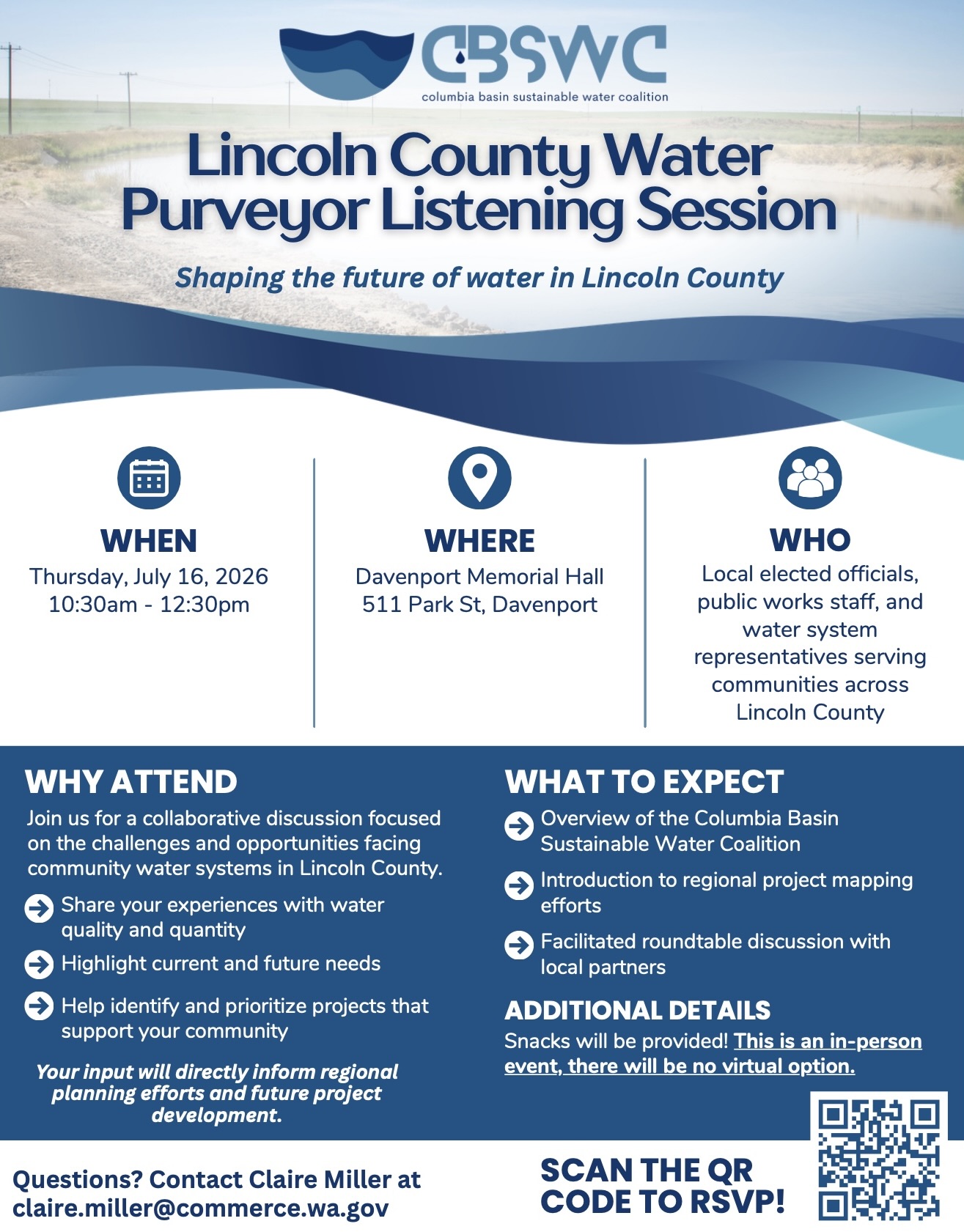
This upcoming Water Purveyor Listening Session is a critical piece of the work that Lincoln Conservation District (LCCD) is conducting with a grant from the Washington Department of Ecology’s Water Resources Program to develop the Mid-Columbia Basin Drought Preparedness Plan. This project focuses on Franklin, Lincoln, Adams, and Grant (FLAG) counties and seeks to identify sustainable solutions that improve water resiliency across this large geographic region.
The project builds upon work that began several years ago through the CBSWC, whose mission is to “address potable groundwater supply issues by creating locally driven recommendations that influence water management and policy, directing resources toward sustainable water solutions.”
With groundwater levels continuing to decline in parts of the region, the Drought Preparedness Plan aims to better understand the challenges facing municipal and small community water systems. The project will help raise awareness, encourage action, support regional groundwater planning efforts, and identify opportunities for new or alternative water sources.
To keep this important work moving forward, the CBSWC Board meets monthly, while stakeholder meetings are held every other month and are open to regional stakeholders and members of the public.
Find out more here: https://www.cbswc.org/meetings
Project partners, including Landau Associates,GeoEngineers, and Water Insecurity Solutions, have been working to assess community characteristics, climate and drought history, water availability, groundwater declines, and associated health risks and disparities. A key component of the project is community engagement, including outreach to Tribal Nations and overburdened communities throughout the project area.
The final Drought Preparedness Plan will include recommended drought mitigation projects and a funding matrix designed to help water purveyors identify financial resources for projects that increase drought resilience and long-term water security.
It is encouraging to see that efforts are already underway to reduce reliance on groundwater in the region. One notable example is the Odessa Groundwater Replacement Program (OGWRP), which is helping provide alternative water supplies in areas impacted by declining aquifers.
As the project enters the community engagement phase, the participation of local water purveyors, as well as Tribal and non tribal community members, is invaluable. Your experiences and insights are critical to understanding how drought affects livelihoods, communities, and the environment, and they will help shape future solutions.